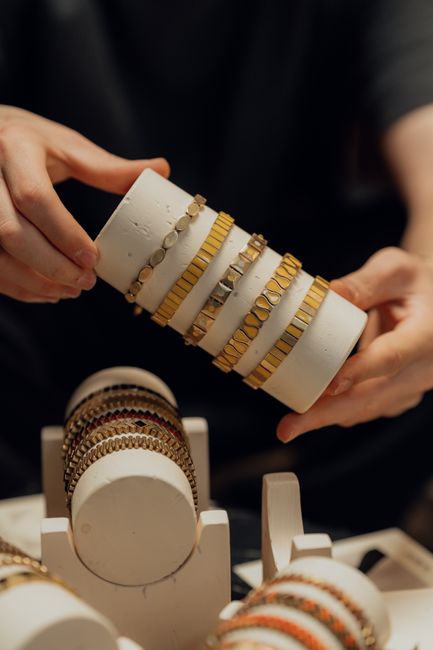
Discover how LunaCraft transforms ethically sourced raw materials into one-of-a-kind handcrafted jewelry — shaped by human hands, not machines.
Every piece of LunaCraft jewelry begins long before a tool is ever lifted. It begins with a question: where did this come from, and does it deserve to become something beautiful?
That question drives everything — the materials chosen, the hours spent at the bench, the decision to finish by hand rather than machine. This is the story of that journey.
Where does LunaCraft's jewelry actually begin — and why does the source of every gemstone and metal matter?
The origin of a material is its first story. And at LunaCraft, we believe that story matters as much as the design itself.
Every metal and gemstone we use is sustainably sourced — traced back to suppliers who follow ethical mining and fair-trade practices. No conflict materials. No environmental shortcuts. No compromises made quietly behind closed doors.
Why does this matter to you as the wearer?
You carry the whole story — not just the beauty of the finished piece, but the integrity of everything it took to create it.
Ethically sourced materials hold energy differently. There is a lightness to wearing something you know was made without harm.
It aligns with purposeful design. A piece meant to honor your unique story shouldn't be built on someone else's suffering.
Our sourcing partners share our belief that beautiful jewelry shouldn't come at the earth's expense. That's not a footnote — it's the foundation.
When rose gold arrives at our bench, we already know its provenance. When a turquoise bead is hand-strung — as with our Turquoise Beaded Bracelet, paired with sterling silver accents for that vibrant, earthy resonance — its origin is already part of its meaning.
The earth gave it. We simply listen to what it wants to become.
What does it look like when sustainably sourced raw materials arrive at the bench before a single tool is lifted?
There is a stillness to this moment that's easy to overlook — but it's one of the most important in the entire process.
Before the first cut, the first hammer strike, the first flame: we look.
Raw materials arrive and are assessed not just for quality, but for character:
Texture. How does the metal catch light? Does it have warmth or coolness in its tone?
Weight. Does it sit with presence or will it need to be layered to feel intentional?
Potential. What form is already living inside this flat sheet, this rough stone, this coiled wire?
This is where artisanal craftsmanship diverges completely from mass production. A factory sees raw material as an input. We see it as a collaborator.
A sheet of rose gold isn't just metal — it's possibility. It already has a warmth between practiced hands that tells you something about what it wants to be. A bohemian feather. A delicate leaf. A question mark suspended mid-air.
It's also here that intentional pairing happens. Which chain weight suits this pendant? Which gauge of silver wire honors the stone without overpowering it? These decisions are made by feel, by eye, by years of knowing the materials intimately.
No algorithm selects them. A human does — and that changes everything.
How does a flat sheet of rose gold become a finished leaf pendant — and what happens in the quiet hours between?
The Rose Gold Leaf Pendant is one of our most beloved pieces — and walking through its creation reveals exactly what handcrafted truly means.
Here is what happens between raw metal and finished pendant:
1. Sketching the Form
The leaf shape is drawn by hand — never printed, never plotted by software. Each sketch captures the organic asymmetry of a real leaf: the slight curve of its spine, the way veins branch with purposeful imperfection.
2. Cutting and Shaping
The rose gold sheet is cut with jeweler's shears, then refined with files and rotary tools. This is where the silhouette takes its first breath. No two cuts are identical — the hand that guides the tool is human, and subtle variations are inevitable. They're also intentional.
3. Texturing the Surface
Using fine stamps and hammers, delicate vein lines are pressed into the metal. The warmth of rose gold deepens under this work — it begins to look less like material and more like something found in a forest.
4. Forming the Curve
The pendant is shaped over a mandrel to give it its gentle, three-dimensional curve. This is the step where it stops being flat and starts having presence — the moment it becomes wearable art.
5. Soldering the Bail
The small loop that will hold the chain is soldered by hand using a jeweler's torch. This joint must be both invisible and strong. It takes patience. It takes practice. It takes knowing that someone will wear this piece every day and trust it completely.
6. Chain Attachment and Adjustment
The pendant is set on an adjustable chain — intentionally so. A piece this personal should sit exactly where you want it to sit.
The quiet hours between these steps? They're filled with checking, correcting, refining. Holding the piece up to light. Turning it over. Asking: is this ready?
Why does handcrafting each piece one at a time create something mass production simply cannot replicate?
Mass production is extraordinary at consistency. It makes the same thing, exactly, ten thousand times.
That is precisely its limitation.
When you wear a mass-produced piece, you are wearing the same object as thousands of others. The jewelry carries no memory of being made — because it wasn't, not in any meaningful sense. A machine pressed a mold. Material filled a cavity. An object emerged.
Handcrafted jewelry works entirely differently:
Every piece carries the fingerprint of its maker. Subtle variations in texture, tone, and line are not flaws — they are the signatures of human hands at work.
Decisions are made in real time. If the metal behaves unexpectedly, the artisan responds. If a stone has a particular depth of color, the setting is adjusted to honor it.
Time is given freely. There is no production quota governing how long a pendant can sit in the maker's hands before it moves forward. It moves forward when it's ready.
Each piece is genuinely one-of-a-kind. Your Rose Gold Leaf Pendant will never be identical to another. Its curve, its texture, its weight — these belong to your piece alone.
This is why artisan jewelry holds meaning differently than something purchased from a fast-fashion retailer. It isn't just an accessory. It is an object with a history — and now, with a future tied to yours.
Other pieces in the LunaCraft family — like the Boho Feather Earrings, crafted with sterling silver feathers inspired by freedom and bohemian spirit, or the luminous Silver Moonstone Ring — carry this same truth. Each one shaped by hand. Each one, unrepeatable.
How do you know when a piece like the Rose Gold Leaf Pendant is truly finished — and ready to carry its story forward?
This is the question only a maker can answer — and it cannot be answered by checklist alone.
The formal review process includes:
Structural integrity check: Every solder joint, every setting, every chain link is examined under magnification.
Surface finish review: The piece is polished and inspected for consistency — then checked again under different light sources.
Proportion and balance: Does it hang true? Does the pendant sit with intention? Does the chain move freely without catching?
Final weight and feel: Picked up, turned over, held. Does it feel like something worth keeping? Worth gifting? Worth passing down?
But beyond the technical checklist, there is a moment of instinct — a knowing. The piece feels complete. It has stopped being a work in progress and started being a story.
From raw material to that moment, a single pendant like the Rose Gold Leaf Pendant can take anywhere from several focused hours to a full day of bench work. That time is not overhead. That time is the value.
At $78, it is not the cheapest leaf pendant you will find. But it is the only one that was made for no one else before it was made for you.
Frequently Asked Questions
What does 'sustainably sourced' actually mean for LunaCraft's jewelry materials?
It means every metal and gemstone is traced back to suppliers who follow ethical mining and fair-trade practices — no conflict materials, no environmental shortcuts. We choose partners who share our belief that beautiful jewelry shouldn't come at the earth's expense.
How long does it take to handcraft a single LunaCraft piece from start to finish?
It varies by design, but most pieces — including the Rose Gold Leaf Pendant — move through several intentional stages: material selection, shaping, setting, finishing, and quality review. From raw material to finished piece, a single pendant can take anywhere from several hours to a full day of focused bench work.
Does 'handcrafted' mean every LunaCraft piece will look slightly different?
Yes — and that's exactly the point. Because each piece is shaped, formed, and finished by hand, subtle variations in texture, tone, and detail are natural. These aren't flaws; they're the fingerprints of the maker, and what make your piece genuinely one-of-a-kind.
Your Piece Is Waiting
The journey from raw earth to wrist is not a quick one. It is deliberate, unhurried, and full of human intention — and that is exactly what makes it worth it.
If this story resonates with you, the Rose Gold Leaf Pendant is in stock now and ready to begin its next chapter — yours.
And if you want to explore the full world of LunaCraft's handcrafted, sustainably sourced jewelry — from bohemian earrings to minimalist sterling silver rings — our complete collection is waiting for you.
Explore all LunaCraft pieces and find the one that carries your story forward.